
Member of the Bundestag Anna Lührmann Visits hessian.AI and RAI
Exchange on Trustworthy AI and Energy Efficiency in Data Centers
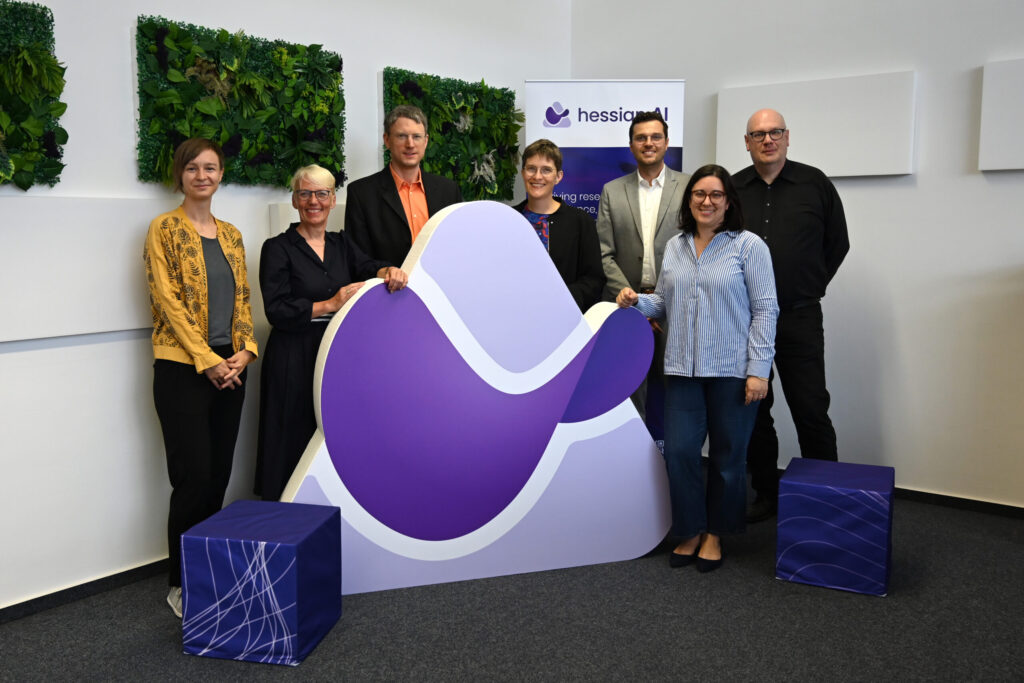
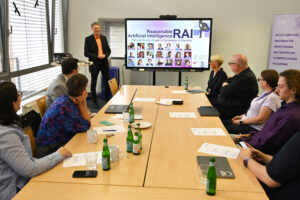
Dr. Anna Lührmann, a member of the German Bundestag from Hesse and vice chair of the Committee on Digital Affairs and State Modernization, visited hessian.AI and the Reasonable AI (RAI) Cluster of Excellence in Darmstadt. Professor Tanja Brühl, president of TU Darmstadt, Professor Marcus Rohrbach, co-spokesperson for RAI, and hessian. AI CEO Dr. Wolfgang Heenes welcomed her to a program that ranged from basic AI research and the rising energy demands of data centers to questions of Europe’s digital sovereignty. Anna Lührmann was accompanied by Nina Eisenhardt, a member of the Hessian State Parliament.
The focus of the visit on August 18, 2026, was an overview of the Hessian Center for Artificial Intelligence (hessian.AI) and the goals of the new Cluster of Excellence Reasonable AI (RAI) at TU Darmstadt. Markus Rohrbach, a professor of computer science and co-spokesperson for RAI, explained how interdisciplinary basic research can make AI more reliable and transparent. He noted that reliability also requires AI systems to learn how to make uncertainty transparent in order to avoid risks to humans. Markus Rohrbach illustrated how this goal can be implemented in practice using the research projects DEFAME (ICML 2025) and VeriTaS (ACL 2026) as examples, which focus on the automated verification of text-image combinations for fact-checking.
More Energy-Efficient Data Centers
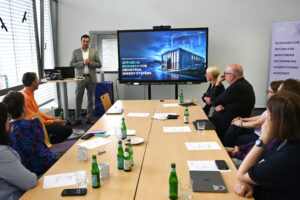
Dr. Lars Petruschke, Chief Operating Officer of the startup etalytics, offered another perspective on responsible AI. Application-oriented research at the Department of Mechanical Engineering at TU Darmstadt has given rise to a successful company with about 90 employees. In the field of data centers, the focus is increasingly shifting toward a more intelligent use of existing energy rather than additional connected load, Lars Petruschke explained from his practical experience. He introduced the attendees to a “conductor” for complex energy systems that works with digital twins, real-world measurement data, and mathematical optimization. etalytics received support in 2023 through the “IGNITION” incubator run by AI Startup Rising, a funding initiative of hessian.AI.
Focus on European Values
The ensuing discussion expanded to address the issue of Europe’s digital sovereignty. Tanja Brühl emphasized the value of responsible science that places European values at the center of the development of a new generation of artificial intelligence. Given the current dominance of the U.S. and China in the field of AI, Markus Rohrbach expressed confidence: AI is a technology that will shape long-term developments in society and the economy. Europe’s commitment to and investments in AI research and technologies are definitely worthwhile. However, the outcome of the technology race depends not only on decisions made by companies, but also on those made by society.
Broad expertise in working with AI is necessary
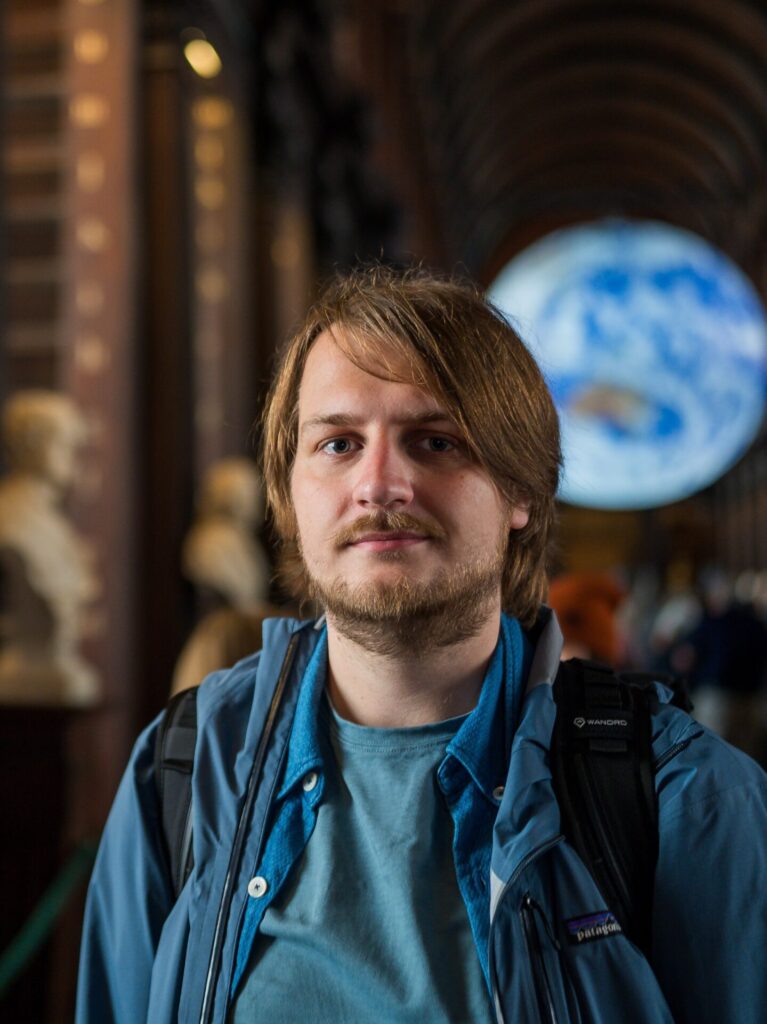
Jannis Blüml also made it clear that technical solutions alone are not enough. Through a program offered by the RAI Cluster of Excellence, the doctoral student is serving as an intern at the Frankfurter Allgemeine Zeitung from July through September 2026. According to Jannis Blüml, the general public, schools, policymakers, and government officials need the skills to evaluate sources and avoid blindly relying on AI-generated answers.
At the end of the visit, the participants were able to briefly visit Professor Georgia Chalvatzaki’s robotics lab, where researchers are studying robots that learn from interacting with people and their environment.