Making an academic future feel less abstract
FSTA winner Leonie Schüßler shares her experience from ECCV 2026
Do we still need workshops and funding opportunities specifically for women? This question from a panel discussion stayed with Leonie Schüßler, a Master’s student at the Department of Computer Science at TU Darmstadt. It was raised at the Women in Computer Vision workshop at the European Conference on Computer Vision (ECCV) in Malmö, which Leonie attended with a Female Student Travel Award (FSTA) 2026 sponsored by hessian.AI. In her report, she shares what she experienced at the conference and how the panel approached the question.
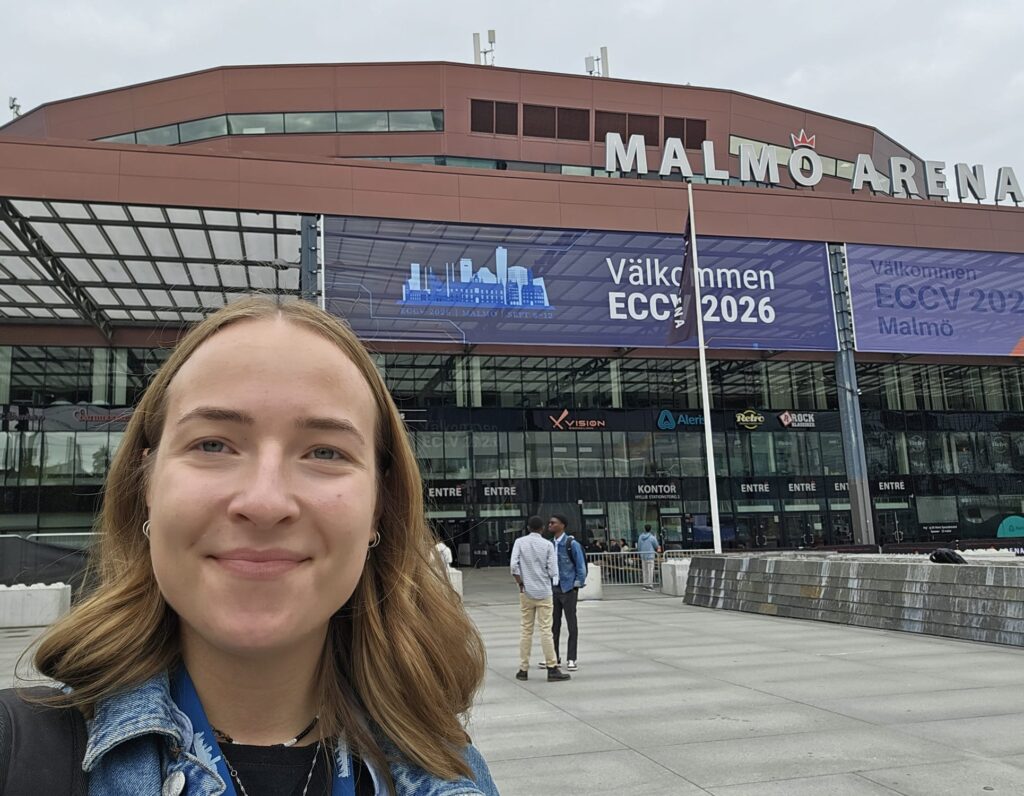
From 8 – 12 September 2026, the European Conference on Computer Vision (ECCV) took place in Malmö, Sweden. Thanks to the Female Student Travel award of TU Darmstadt and the sponsorship by hessian.AI, I had the opportunity to attend this event and meet researchers from all over the world who work on different aspects of computer vision. One of my personal highlights, however, took place before the main conference even started: The Women in Computer Vision (WiCV) workshop.
Connecting Women in Computer Vision
WiCV has been held at major computer vision conferences for more than 10 years, with the goal of increasing the visibility of women in this field and strengthening the sense of community. Female researchers can present their work in oral presentations or poster sessions. Compared to other workshops, which primarily focus on presenting technical research, WiCV deliberately leaves room for a casual setting in which participants can meet other women in the field and build connections with collaborators, mentors or simply potential friends. Having already attended a WiCV edition at another conference earlier this year, I was very much looking forward to taking part again.
The scientific program itself features several inspiring keynote talks from accomplished researchers. Anna Kukleva, a research scientist at Meta who completed her PhD and worked as a Postdoc at the Max Planck Institute for Informatics, spoke about representation learning under limited supervision, for example when working with thermal images. Laura Leal-Taixé, Senior Research Manager at NVIDIA and Adjunct Professor at the University of Toronto, presented her work on multimodality and controllable generative simulation. I was particularly interested in Gül Varol’s keynote, which, besides insights into her research on sign language detection also included a personal anecdote of her involvement with WiCV since 2016. She spoke about how participating in the workshop had led to lasting friendships and research collaborations over the years, which was a good reminder that meeting and talking to new people at conferences is just as important as the scientific discussions themselves.
What community and role models change
At the end of the workshop, the keynote speakers took part in a panel discussion to answer questions from the audience. One question in particular stayed with me: Do we still need women-specific workshops, awards, and grants or should we simply focus on applying to the same general opportunities as everyone else? To me, this question felt specifically relevant, as my own participation in ECCV was made possible by the FSTA, a female-specific travel award. The discussion that followed did not suggest that the answer is to create separate opportunities indefinitely. Instead, such opportunities can be considered a means to an end: We are still in a transition phase, and despite computer vision becoming one of the largest computer science research communities, the percentage of female faculty members and researchers remains relatively low. Initiatives such as WiCV (or the FSTA, for that matter) contribute to making this distribution more equal by creating a sense of community, making women in research more visible and also providing role models. As a practical effect, the more women feel encouraged to apply for whatever grant, award, or job, the more diverse and representative the applicant pool itself becomes, which is the outcome we ideally want.
For me personally, it was a refreshing change of scenery to walk into a room that was (mostly) filled with female researchers. More often than not, one is surrounded by considerably more men in an academic environment, to the point where that becomes the “normal”. Seeing women at different stages in their career and on different career paths all in one place also makes the idea of pursuing a future in academia feel much less abstract to me.
About the author
Leonie Schüßler, is a master student in Artificial Intelligence and Machine Learning at TU Darmstadt. Her research interest span Computer Vision, including Visual Understanding, Representation Learning and Interpretability.
Picture: Leonie Schüßler