
AI in medicine and sustainable cocoa farming
Dr Hans Messer Foundation Prize honours two female researchers from TU Darmstadt
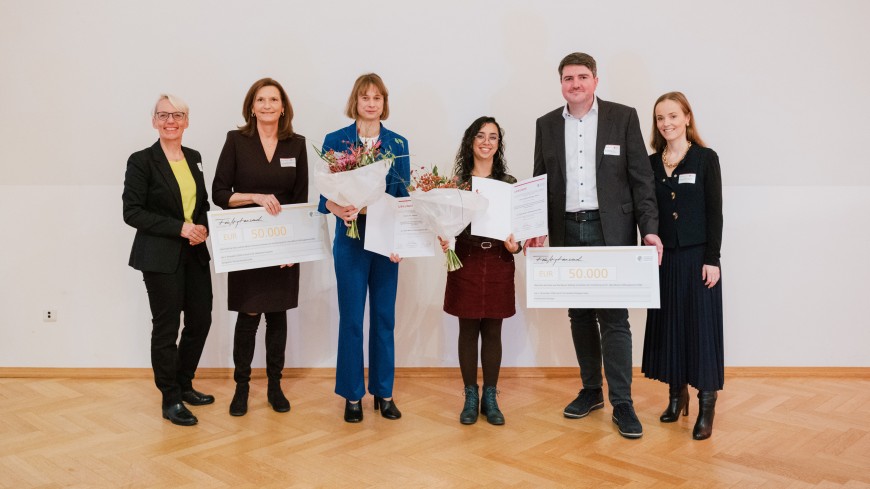
Professor Ekaterina Jussupow from the Department of Law and Economics and Dr Carolina Ocampo-Ariza from the Department of Biology at TU Darmstadt were awarded the Dr Hans Messer Foundation Prize yesterday (5 November 2026). The researchers plan to use the prize money to fund projects of great relevance to society and the natural world.
This year’s Dr Hans Messer Foundation Prize honours two female researchers at TU Darmstadt who are conducting forward-looking and application-oriented research in very different fields. Professor Ekaterina Jussupow, who has been a tenure-track professor in the Chair of Information Systems since March 2023, analyses human–AI interactions. She aims to understand how the increasing use of AI is changing human thought and behaviour. Dr Carolina Ocampo-Ariza, a postdoctoral researcher in the Ecological Networks research group since April 2025, is researching insectivorous insects and other arthropods. She is working on environmentally friendly alternatives to chemical pesticides in agriculture. Both researchers will use the prize money of 50,000 euros each to carry out studies in real-world environments.
Jussupow, a qualified psychologist, is planning a study at the University of Toronto Hospital. There, she intends to observe doctors as they introduce an AI system that analyses X-ray images and automatically generates reports. Using specialised data collection methods and interview techniques, Jussupow will investigate how the AI system influences medical expertise and decision-making. The findings will answer key questions about the future of digital medicine and are also essential for legislation governing AI. The jury recognised the high social and scientific relevance of Jussupow’s research question, its great significance for medical practice, and its topicality in light of the increasing use of AI in medicine.
Biologist Ocampo-Ariza’s project focuses on cocoa cultivation in the Ivory Coast, which is under threat from pests and plant diseases. She will study specific pest-eating ants and spiders that occur naturally in the plantations. If suitable growing conditions are established, these arthropods could replace chemical pesticides. In this way, Ocampo-Ariza aims to combine nature conservation and biodiversity protection with increased agricultural yields. The jury praised the project’s high social and environmental relevance, its contribution to more sustainable agriculture, and its strong focus on practical application.
Both prize-winners are at the start of their academic careers. Jussupow is still expanding her research group, whilst Ocampo-Ariza is working on her habilitation thesis. The generously endowed Dr Hans Messer Foundation Prize offers both a springboard to larger projects. Both Jussupow and Ocampo-Ariza intend to use the data and findings they will gain from their planned projects to apply for funding from the European Research Council.
The prize-winners have plenty of ideas for future studies, particularly as their unconventional approaches are identifying gaps in research that urgently need to be addressed. If humanity is to retain control over AI systems, and if agriculture is to sustainably provide food for a growing global population, scientific research such as that carried out by Jussupow and Ocampo-Ariza is indispensable. In its joint statement explaining the selection of both prize-winners, the jury highlighted their innovative research approaches as well as the courage of the researchers in tackling challenging and socially significant research questions.
About the award
The Dr. Hans Messer Foundation Prize, presented by the Hans and Ria Messer Foundation (known as the Dr. Hans Messer Foundation until 2024), is awarded annually to support research and teaching. It honors early-career researchers who have demonstrated outstanding achievements in the natural sciences, engineering, economics, social sciences, or the humanities. In honour of the principal founder and benefactor, Dr Hans Messer, who would have turned 100 in 2025, the prize money was doubled to 100,000 euros last year.
The Hans and Ria Messer Foundation promotes education and training, as well as science and research, throughout Germany. The foundation was established in 1978 by Dr. Hans Messer and has been recognized as a non-profit organization since 1979. Under the leadership of Dr. Hans Messer, the foundation also introduced the Foundation Award at Technische Universität Darmstadt. The foundation supports research projects, assists scientific and educational institutions, and regularly awards scholarships for education and research. The Foundation Award has been presented regularly at TU Darmstadt since 1994. It is currently the university’s most highly endowed award for early career researchers.
Uta Neubauer/mih, TU Darmstadt
photo: Paul Abendschein