

On 2 October 2026, the Department of Computer Science at TU Darmstadt celebrates the inaugural session of their new distinguished lecture series. With the DLS, they aim to bring some of the world’s leading researchers and innovators to Darmstadt to share the ideas that are shaping the future of computer science. The Cluster of Excellence “Reasonable AI” (RAI) and hessian.AI are delighted to support the event. The inaugural Distinguished Lecture will feature RAI Fellow Prof. Leslie Kaelbling from the Massachusetts Institute of Technology (MIT). She is one of the major pioneers of agentic AI and robotics.
In her lecture, Prof. Kaelbling will present an explicitly rational approach to designing intelligent robots, a topic at the heart of today’s advances in agentic AI and autonomous systems. The event is open to everyone at Technical University of Darmstadt, the Rhein-Main Universities Alliance, and anyone beyond interested in AI, robotics, and the future of intelligent systems.
Computer Science Distinguished Lecture #1
Speaker: Professor Leslie Kaelbling, MIT
Talk: “Rational Robots”
Date/Time: 2 October 2026, 2:00 PM
Location: TU Darmstadt, Magdalenenstraße 12, Maschinenhaus (S1|05, 122), 64289 Darmstadt
Registration and further information
📖 Abstract & speaker biography at TUDa
👉 Regististration (PreTix)
Researchers from hessian.AI and the DFG Excellence Cluster “Reasonable AI” have picked up two top paper awards at leading international conferences in July. One team built a fact-checking benchmark designed to stay accurate as AI models keep learning from the internet. The other team found a way to train robots faster without sacrificing the stability needed for real-world deployment.
VeriTaS: a benchmark that keeps up with misinformation
The paper “VeriTaS” received the Best Resource Paper Award at ACL 2026, the 64th Annual Meeting of the Association for Computational Linguistics, held in San Diego, USA.
“VeriTaS: The First Dynamic Benchmark for Multimodal Automated Fact-Checking“
by Mark Rothermel, Marcus Kornmann, Marcus Rohrbach, Anna Rohrbach
Abstract: The growing scale of online misinformation urgently demands Automated Fact-Checking (AFC). Existing benchmarks for evaluating AFC systems, however, are largely limited in terms of task scope, modalities, domain, language diversity, realism, or coverage of misinformation types. Critically, they are static, thus subject to data leakage as their claims enter the pretraining corpora of LLMs. As a result, benchmark performance no longer reliably reflects the actual ability to verify claims.
We introduce Verified Theses and Statements (VERITAS), the first dynamic benchmark for multimodal AFC, designed to remain robust under ongoing large-scale pretraining of foundation models. VERITAS currently comprises 25,000 real-world claims from 104 professional fact-checking organizations across 54 languages, covering textual and audiovisual content. Claims are added quarterly via a fully automated seven-stage pipeline that normalizes claim formulation, retrieves original media, and maps heterogeneous expert verdicts to a novel, standardized, and disentangled scoring scheme with textual justifications.
Through human evaluation, we demonstrate that the automated annotations closely match human judgments. We commit to updating VERITAS in the future, establishing a leakage-resistant benchmark, supporting meaningful AFC evaluation in the era of rapidly evolving foundation models. The code and data are publicly available under veritas.mai.informatik.tu-darmstadt.de.
This work was carried out at the Multimodal AI Lab at TU Darmstadt and hessian.AI, with support from the hessian.AI Service Center and the hessian.AI Innovation Lab with partial funding from LOEWE professorship program and the Alexander von Humboldt professorship program, and has benefited from the DFG Excellence Cluster “Reasonable AI” (RAI).
FlashSAC: faster, more stable robot learning
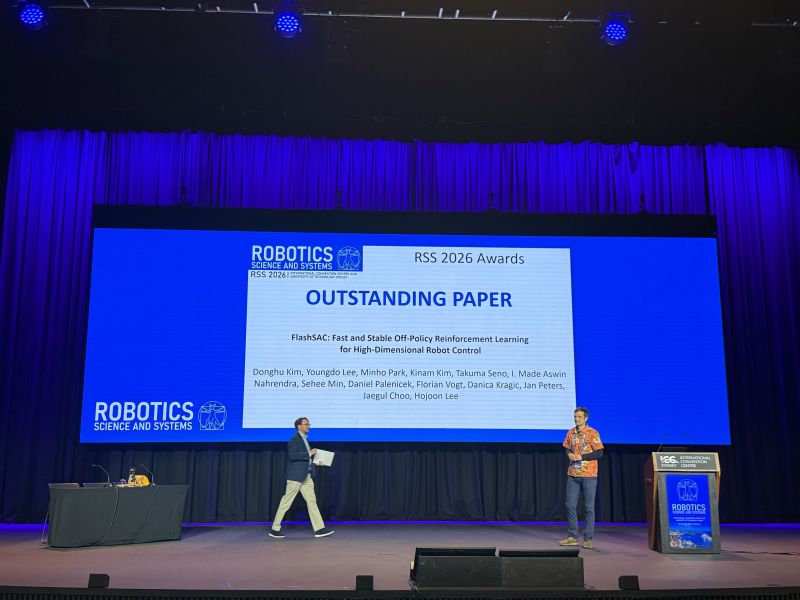
The paper “FlashSAC” received the Outstanding Paper Award, RSS’s top paper honor, at RSS 2026, the 22nd Robotics: Science and Systems conference, held in Sydney, Australia.
“FlashSAC: Fast and Stable Off-Policy Reinforcement Learning for High-Dimensional Robot Control“
by Donghu Kim, Youngdo Lee, Minho Park, Kinam Kim, Takuma Seno, I. Made Aswin Nahrendra, Sehee Min, Daniel Palenicek, Florian Vogt, Danica Kragic, Jan Peters, Jaegul Choo, Hojoon Lee
Abstract: Simulation-based reinforcement learning (RL) is central for robotic control when expert demonstrations are unavailable. However, scaling RL to high-dimensional robots remains challenging. On-policy methods such as PPO are reliable but require large amounts of simulation because they discard past data. Off-policy methods can reuse experience and are more sample-efficient, but they often become unstable in high-dimensional control due to critic errors that are amplified during bootstrapped updates.
We introduce FlashSAC, a fast and stable off-policy RL algorithm for high-dimensional robotic control. FlashSAC improves training stability in two ways: (1) it explicitly bounds weight, feature, and gradient norms to limit critic error amplification, and (2) it increases data coverage through large-scale parallel simulation, a high-capacity replay buffer, and strong exploration. These design choices preserve the sample efficiency of off-policy learning while improving training stability.
Across 50+ state-based and vision-based tasks in 10 simulators, FlashSAC consistently surpasses PPO and strong off-policy baselines in both final performance and wall-clock efficiency, with larger gains on higher-dimensional tasks. In sim-to-real humanoid walking, FlashSAC reduces training time from hours to minutes while maintaining stable real-world deployment. Our results show that stabilizing off-policy learning enables scalable sim-to-real RL for high-dimensional robotic systems.
Jan Peters and Daniel Palenicek contributed to the work from TU Darmstadt and hessian.AI, with funding from the cluster project “Third Wave of AI,”, hessian.AI, and the DFG Excellence Cluster “Reasonable AI” (RAI), and with partial support from the German Federal Ministry of Research, Technology and Space (BMFTR) through the Robotics Institute Germany.
Prof. Dr. Carsten Binnig is Professor of Data Management at TU Darmstadt and Head of the Department of Data and AI Systems. He is also a founding member of hessian.AI and head of the research area Systemic AI for Decision Support at the Darmstadt site of the German Research Center for Artificial Intelligence DFKI.
Carsten Binning and his team are working on the development of a new generation of AI-centric database systems that are self-optimizing and can also be easily operated by non-IT experts. The expert in artificial intelligence (AI) and data management has now been awarded a LOEWE top professorship at TU Darmstadt. The LOEWE professorship will be funded over five years with around two million euros from LOEWE funds.
State program supports application for “Reasonable Artificial Intelligence” cluster of excellence
By awarding the LOEWE professorship, the state of Hessen is supporting the “Reasonable Artificial Intelligence (RAI)” research project as part of the Excellence Strategy of the German federal and state governments. The planned Cluster of Excellence under the leadership of TU Darmstadt in collaboration with the universities of Frankfurt, Bonn and Würzburg aims to develop the next generation of AI: AI systems that learn with a “reasonable” amount of resources based on “reasonable” data quality and “reasonable” data protection.