
Simulations for foreign exchange trading
hessian.AI Member Prof. Dominik Michels from TU Darmstadt, and Commerzbank develop agent-based models
How do price movements arise in the foreign exchange markets? And how can trading strategies be developed and analysed without interfering with real markets? Researchers at TU Darmstadt are investigating these questions in collaboration with Commerzbank. Using a hybrid research approach, they combine mathematical modelling, agent-based simulations and artificial intelligence (AI). The aim is to simulate key mechanisms of the foreign exchange market under controlled conditions that are as close to reality as possible.
To this end, the researchers use an agent-based approach: they model different market participants as autonomous agents, each of whom pursues their own trading strategies and reacts to the others. Their interactions give rise to market dynamics and price movements within the model.
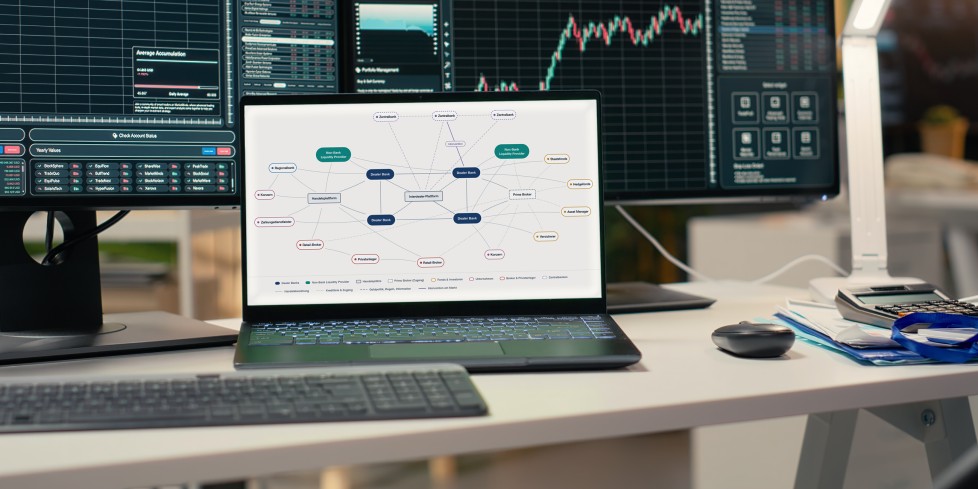
Picture: Fachgebiet IAMS The foreign exchange market has no central trading venue: each participant trades directly with those with whom they have a relationship. Accordingly, in the model, each individual participant is modeled as an agent and the market as a whole emerges only from their interaction.
“The key point of our approach is that we do not describe the market as a single system based on predefined assumptions about its behaviour,” says Professor Dominik L. Michels, head of the Intelligent Algorithms in Modelling and Simulation group at the Department of Computer Science at TU Darmstadt and a researcher at hessian.AI. “Instead, we model the individual market participants as autonomous agents, each with their own decision-making processes and interactions. The dynamics of the overall system then arise from the interaction between these agents. Of course, suitable models and assumptions must also be developed at the level of the individual agents and their interactions – but we do not need to prescribe the behaviour of the overall market in abstract terms.”
Bringing together different perspectives
The hybrid research approach aims to bring together different perspectives on complex financial markets. Unlike purely data-driven methods, it combines AI with mathematical models of complex systems and agent-based simulations. On this basis, trading strategies can be systematically developed, tested and evaluated in the simulation. The results are intended, in particular, to contribute to a better understanding of the processes and mechanisms involved in foreign exchange trading.
“In the long term, this approach has the potential to provide a better understanding of decision-making processes in trading and to make complex market mechanisms more transparent,” says Michels.
“Whether you’re a medium-sized exporter or an asset manager operating internationally, the use of agent-based AI makes our foreign exchange trading even more competitive and relevant for all client groups,” says Hinrich W. Paul, Global Head of Financial Markets at Commerzbank. “Our collaboration with Professor Michels is another building block in the AI-driven development of our trading business. It is a prime example of how, together with a renowned international research team here in the Frankfurt financial centre, we are translating modern AI methods into concrete, practical applications – with the aim of offering our clients even better solutions.”
cst/df/TUDa