
Google PhD Fellowship for computer science PhD student Tim Schneider
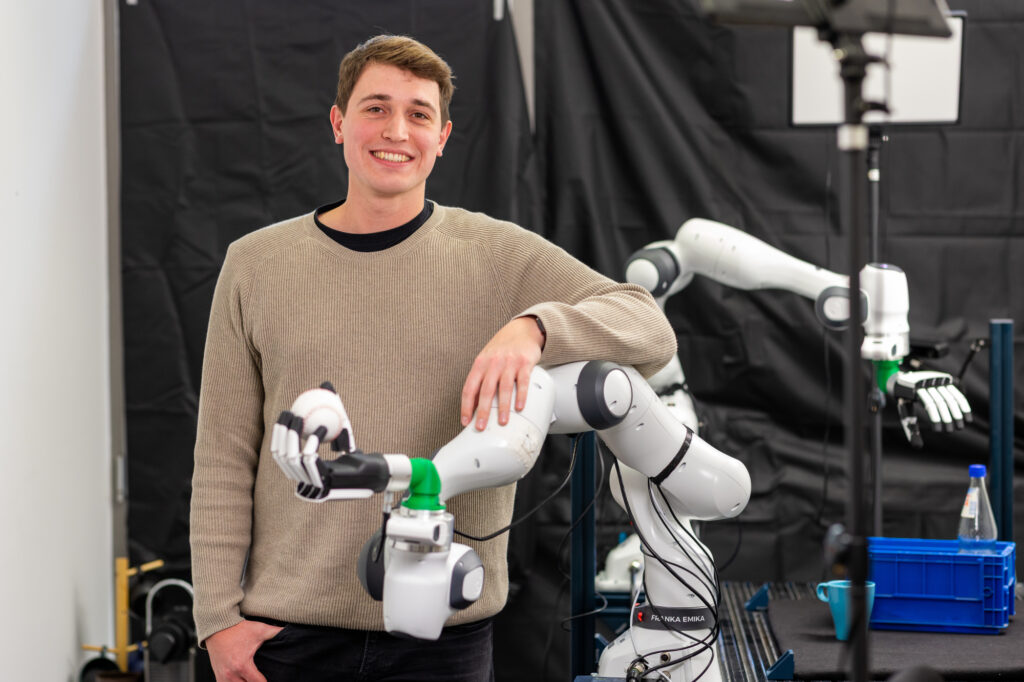
Tim Schneider, a PhD student in Professor Jan Peters’ Intelligent Autonomous Systems (IAS) group within the Department of Computer Science, has been awarded a Google PhD Fellowship in the ‘Machine Learning and ML Foundations’ category. He is the first PhD student at TU Darmstadt to be selected for the programme. Google.org will initially fund his research for one year.
In his project, Schneider is using reinforcement learning to teach robots active tactile perception: using touch sensors, they gather information about an object and its surface in order to recognise it. If the robot makes the correct judgement, it is rewarded and thus learns independently how best to feel its way. In the long term, this should enable robots to become skilful enough to work in households or on building sites. Schneider discusses the fellowship and his research in more detail in an interview on the Department of Computer Science’s website.
Through the Google PhD Fellowship Programme, Google recognises PhD students who are carrying out outstanding work in computer science, related disciplines or promising fields of research. The fellowships provide direct support for the PhD and also connect the recipients with a mentor from Google Research.
About the scholarship holder
Tim Schneider is a PhD student in the Intelligent Autonomous Systems (IAS) department at TU Darmstadt, working in the research group led by hessian.AI member Prof. Jan Peters. As part of the Aristotle project, he is undertaking a binational PhD in collaboration with Prof. Liming Chen at the École Centrale de Lyon. Prior to this, he completed his Master’s degree in Computer Science at TU Darmstadt with a thesis on active exploration for robotic manipulation. His research combines active perception, tactile sensing and robotic manipulation. His aim is for robots to learn to explore and understand their environment through touch and physical interaction, much like children do.
About the Google PhD Fellowship
The Google PhD Fellowship was launched in 2009 to recognise and support outstanding PhD students in computer science and related fields. It is aimed at young researchers who wish to help shape the future of technology through innovative research, and provides them with financial support for their PhD studies. Universities can nominate only a limited number of candidates each year – in Europe, a maximum of three per university. Since 2009, the Google PhD Fellowship programme has supported more than 1,100 PhD students worldwide. Over the past 17 years, former participants in the programme have gone on to become tenured professors, start-up founders, open-source pioneers and leading researchers who are helping to shape the future of technology.
Department of Computer Science / pg
Photo: Daniela Fleckenstein