


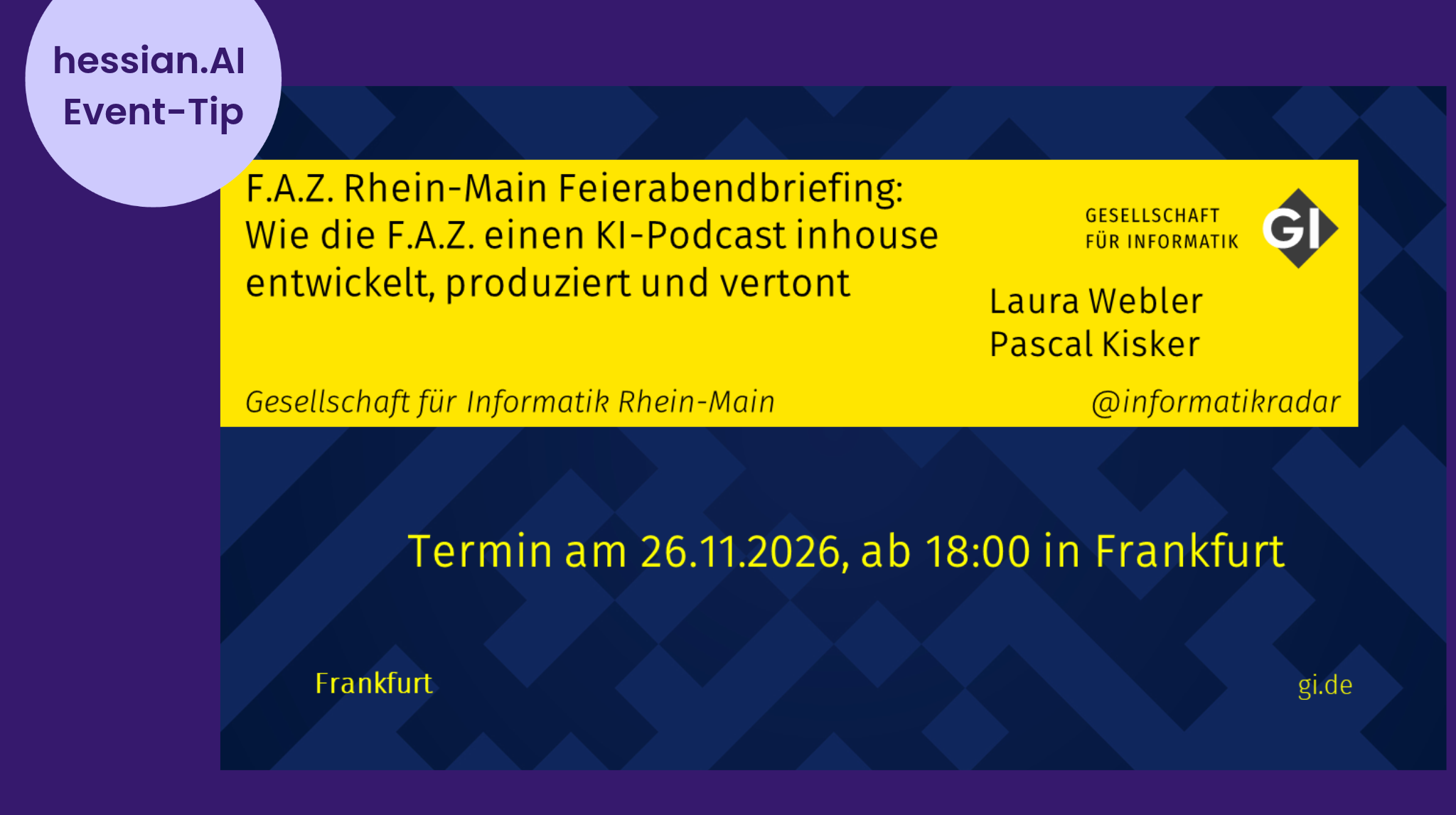
F.A.Z. Rhein-Main Feierabendbriefing: How F.A.Z. Builds an AI Podcast In-House | GI Regional Group Rhein-Main
How do you turn an editorial idea into an AI-supported audio format that runs every day in a live newsroom? Laura Webler and Pascal Kisker share how F.A.Z. built its “Rhein-Main Feierabendbriefing” in-house.
How does an editorial idea become an AI-supported audio format that works reliably in daily news operations? Using the “F.A.Z. Rhein-Main Feierabendbriefing” as an example, Laura Webler and Pascal Kisker show how the Frankfurter Allgemeine Zeitung developed the format in-house and built it into its editorial workflows.
The talk follows the whole process: the first idea, building the F.A.Z. podcast platform, training an AI voice, the first test runs and the launch in the newsroom. It also covers legal questions, quality assurance and what AI can and can’t do in daily audio production.
To wrap up, the speakers look ahead at how AI-supported audio formats might develop in the future.
The Speakers:
Laura Webler, Product Manager Audio & Podcasts, Frankfurter Allgemeine Zeitung
Laura is responsible for the strategic development, reach and monetization of the F.A.Z. audio and podcast portfolio. For the “Rhein-Main Feierabendbriefing”, she led the concept and preparation of the format, oversaw the creation of the voice clone and coordinated the launch with the editorial team.
Pascal Kisker, Generative AI Specialist, Frankfurter Allgemeine Zeitung
Pascal develops AI applications and automations for the newsroom and the publishing house. He focuses on the technical design of generative AI solutions, agents and workflows and on integrating them into existing systems. He built the F.A.Z. podcast platform, which produces several audio formats with the help of AI. One of them is the “Rhein-Main Feierabendbriefing”, which is created automatically every day together with the editorial team. He also takes AI projects from the first idea through prototyping to production.